
5 minute read
Illegal, unreported, and unregulated (IUU) fishing threatens global fish stocks and the food security of coastal nations that rely on fish as a primary protein source.
The Food and Agriculture Organization (FAO) of the United Nations estimates 26 million tons of fish are caught using IUU fishing each year. That means one in every five fish that make it to consumer plates were caught illegally. To make matters worse, IUU fishing also perpetuates other crimes at sea such as forced labor exploitation and human trafficking.

Threats to Pacific Islands
Among developing nations, Small Island Developing States (SIDS) in Oceania are among the most vulnerable to IUU fishing. While Oceania is one of the largest territorial areas comprised of 12 archipelagic states, it is considered one of the smallest in terms of land mass, demography, and economic size (excluding Australia and New Zealand). These archipelagic states consist of Papua New Guinea, Fiji, Solomon Islands, Federated States of Micronesia, Vanuatu, Samoa, Kiribati, Tonga, The Marshall Islands, Palau, Tuvalu, and Nauru, all of whom are classified as SIDS by the UN.
The primary constraints to economic growth for Pacific SIDS are small populations in remote locations, vulnerability to natural disasters, natural resource and tourism management challenges, and political and social stability. They are also at risk for food insecurity as fish is their primary protein and income source. As a result, the impacts of IUU fishing and changing ocean conditions threaten the national security of these developing nations.
Oceania is home to the world’s largest tuna fishery, which plays a vital role in the economic development, future prosperity, and food security for SIDS. Access fees paid by commercial fishing fleets to fish within the Exclusive Economic Zone (EEZ) of SIDS account for significant proportions of government’s total revenue. At the low end, access fees make up 4% of Papua New Guinea’s GDP at USD $134.3 million. At the top end of the more “tuna dependent” states like Tokelau, access fees make up 84% of total government revenue at only USD $13.4 million.
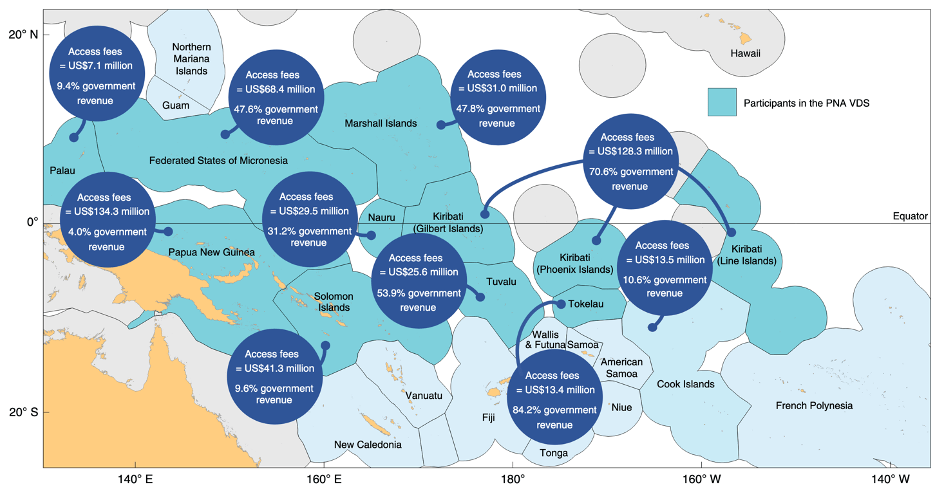
This critical resource faces significant threats due to the compounding effects of IUU fishing and rising ocean temperatures. Unaccounted catch from IUU fishing makes it significantly more challenging for fisheries managers to develop accurate stock assessments. Meanwhile, the stocks of highly migratory species like tuna are shifting with changing ocean conditions. Scientists estimate the tuna biomass will migrate toward the high seas due to rising ocean temperatures, and away from the jurisdictional range and EEZ’s of Pacific SIDS. As a result, even more of the tuna stock would be vulnerable to IUU fishing.
Recent U.S. Foreign Policy Trends
The United States historically contributes a significant amount of resources and funding to promoting trade and investment ties, enhance climate and economic resilience, and strengthen the infrastructure of Pacific SIDS through the South Pacific Tuna Treaty, which first entered into force in 1988. The U.S. Navy and Coast Guard regularly deploy ships to Oceania for counter IUU fishing and capacity building missions with Pacific SIDS as part of the U.S. Indo-Pacific Strategy. In 2023, the Biden Administration committed $600 million to be allocated over 10 years as part of an economic assistance agreement that supports economic development, climate resilience, and fisheries management programs in Oceania.
Today, the Trump Administration is working to withdraw foreign aid as part of its America First agenda. One of the administration’s first priorities was to shut down the U.S. Agency for International Development (USAID). USAID projects in 2024 provided support for small-scale fishers and local fisheries management programs, prevented child labor, and forced labor at sea, and funded equipment to enhance fishing vessel monitoring and illegal fishing reporting in developing countries around the world. On March 10th, 2025 Secretary of State, Marco Rubio confirmed 83% of USAID programs were cut, approximately 5,200 of 6,200 programs and nearly USD $54 billion in foreign aid. The remaining USAID programs will be transferred to the Department of State, essentially dissolving the agency.
The Future Outlook for Pacific Islands
The growing threats of IUU fishing and rising ocean temperatures will continue to disproportionately affect the developing island states of Oceania. As the demand for tuna increases among the world’s most developed nations, so will the incentive to overfish or utilize IUU fishing to satisfy consumer demand. Without continued intervention and support for Pacific SIDS, rising ocean temperatures will drive valuable fish stocks away and illegal fishers will continue to exploit gaps in fisheries governance while sea level rise threatens the very existence of Pacific Island nations.

About the Author: Submitted Anonymously: The author is completing a Master of Marine Affairs degree at the University of Rhode Island. Upon graduation, they will be working to develop federal policy around international fisheries management in Washington, DC.
This article was written for MAF/APG471_Sp25, I attest that I am the author of this article and have responsibly referenced my sources throughout the article. I have given Prof. Lloréns permission to anonymously publish it on her website.
 hildallorens.com